
Importing doors from China has become a proven business model for distributors, builders, and entrepreneurs worldwide. Chinese manufacturers supply over 60% of the world’s entry doors, offering competitive pricing, extensive customization, and quality that has improved dramatically over the past decade.
This guide walks you through every step of the import process — from finding the right factory to receiving your first container.
Step 1: Find a Reliable Door Factory
Your success starts with choosing the right manufacturing partner. Here are the key factors to evaluate:
Factory Location
Most Chinese door factories are concentrated in Guangdong Province (Foshan, Guangzhou), Zhejiang, and Shandong. Foshan’s Shiwan area is particularly known for premium door manufacturing. Factories in this region have decades of export experience and access to high-quality raw materials.
Production Capabilities
A reliable factory should have in-house CNC machining, powder coating lines, and quality control stations. Visit the factory or request a video tour. At SJ DOORS, our 5000m² facility is equipped with German CNC machinery and automated production lines.
Certifications and Compliance
Depending on your target market, your factory should provide relevant certifications: CE for Europe, FCC for North America, SONCAP for Nigeria. ISO 9001 certification is a baseline indicator of quality management systems.
Communication and Responsiveness
Time zone differences make communication critical. A good factory responds within 24 hours, provides regular production updates, and assigns a dedicated export manager to your account.
Step 2: Understand Pricing and MOQ
Chinese door pricing typically uses EXW (Ex Works) or FOB (Free on Board) terms:
- EXW: Price covers the product only. You arrange all shipping from the factory door
- FOB: Price includes delivery to the departure port (usually Shenzhen or Guangzhou)
Minimum order quantities vary by factory and product type. Standard models typically require 10-50 units, while custom designs may require 50-100 units. Contact SJ DOORS for current pricing and MOQ details.
Step 3: Quality Control
Quality control should never be skipped. A systematic QC process includes:
- Raw material inspection: Verify steel/aluminum gauge, wood quality, glass thickness
- In-production checks: Monitor welding quality, paint application, hardware installation
- Pre-shipment inspection: Final check of dimensions, finish, operation, packaging
Step 4: Shipping and Logistics
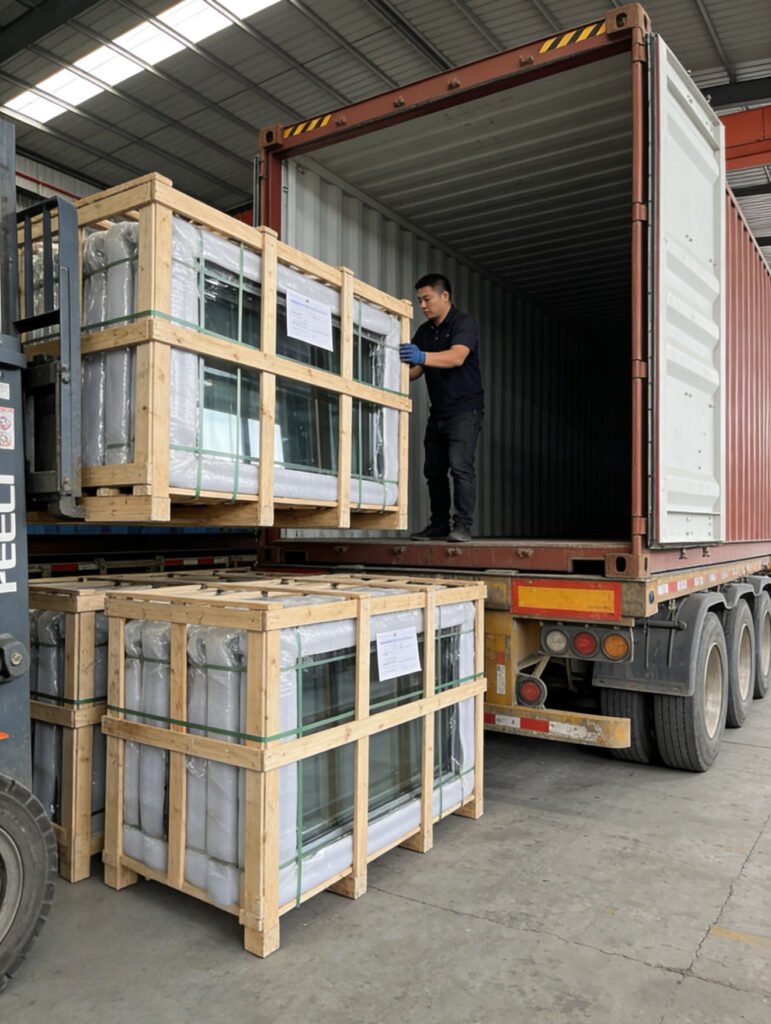
Most door shipments use sea freight. A 20-foot container holds approximately 40-60 doors depending on size. Shipping times from China to major global ports range from 20 to 35 days. Your factory should provide complete export documentation including the Bill of Lading, packing list, commercial invoice, and certificate of origin.
Step 5: Customs Clearance
Each country has specific import requirements. Work with a customs broker in your destination country to ensure all documentation is correct. Common requirements include:
- Bill of Lading
- Commercial invoice (showing product value and HS code)
- Packing list
- Certificate of origin
- Import license (varies by country)
The HS code for entry doors is typically 4418.20 (wood), 7308.30 (steel), or 7610.10 (aluminum). Confirm the correct code with your customs broker.
Calculate Your Total Landed Cost
Your total cost includes: factory price + export packaging + freight + insurance + import duties + customs broker fees + inland transportation. A good rule of thumb: add 25-35% to the FOB price for total landed cost.
Start Your Door Import Business
Importing doors from China is a proven path to building a profitable door business. With the right factory partner, you get premium products at factory-direct prices with full customization support and reliable quality.
“`